Building near Newcastle Airport and RAAF Base Williamtown
Newcastle Airport's passenger flights share a runway with the Air Force's F-35A fighters at Williamtown, 30 km north of Newcastle. If you're building or renovating near the base, Port Stephens Council will want the design to keep aircraft noise out, and in the noisiest areas new homes are generally ruled out.
One runway, two kinds of flying
RAAF Base Williamtown has a single runway, 12/30, running north-west to south-east. It's Australia's main fighter pilot training base. F-35A Lightning II squadrons, Hawk 127 and PC-21 training aircraft and E-7A Wedgetail surveillance aircraft are all based there.
Newcastle Airport's terminal is on the southern side of the base, and its flights use the same runway. The airport company is owned by City of Newcastle and Port Stephens Council. Runway and taxiway works finished in 2024 to take wide-bodied aircraft such as the Airbus A330 and Boeing 777.
About 6 km north-east of the base is the Salt Ash Air Weapons Range, where F-35A, Hawk and PC-21 crews practise air-to-surface gunnery and bombing. It can be used on a rolling average of 115 days a year.
Defence's monthly noise reports show the mix. In July 2026 there were 1,118 civil jet take-offs and landings, 802 by military fast jets and 475 by civil propeller aircraft.
The Williamtown ANEF
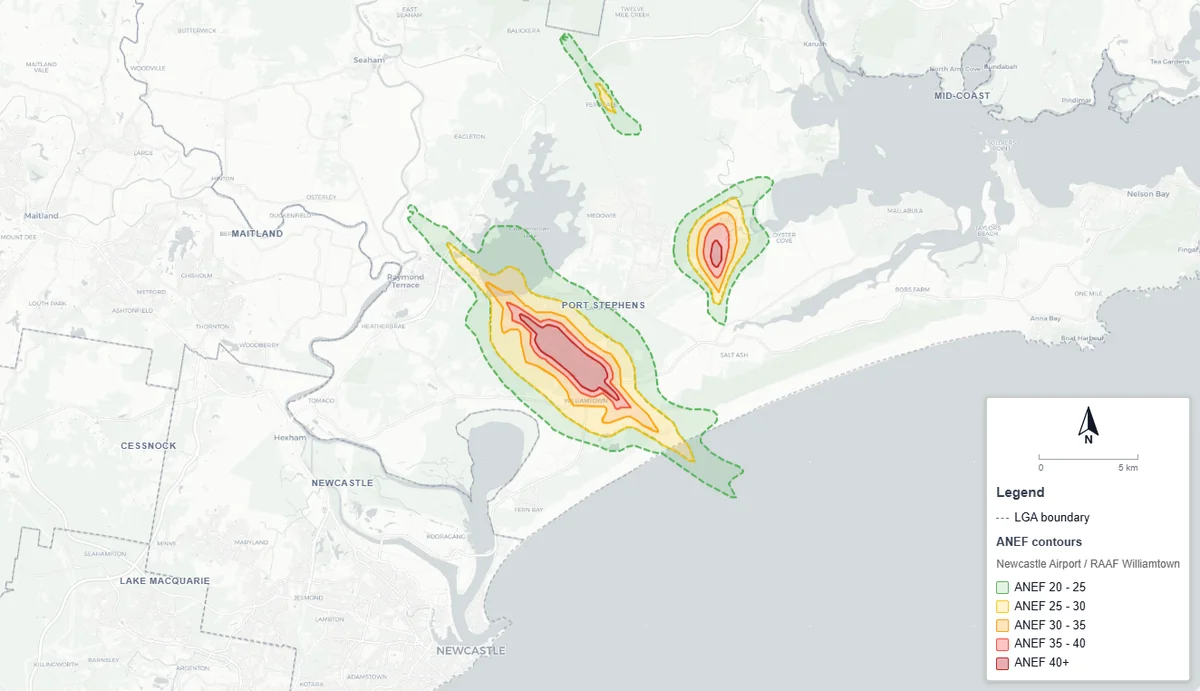
Defence prepares the ANEF for Williamtown, and it covers civil flights as well as military ones. The current map is the RAAF Base Williamtown & Salt Ash Air Weapons Range 2025 ANEF, based on a forecast made in August 2011 for the year 2025. It's still the only Williamtown ANEF Defence lists, and an ANEF stays in use after its forecast year until a new one replaces it.
An update to the ANEF was discussed at the base's community advisory group in June 2024, but no new map has been published. If your site is close to a contour line, ask council which map it's applying.
The contours form a long band along the runway, over Williamtown and out to Stockton Bight, with a smaller set around the Salt Ash range and a small patch further north. Port Stephens Council treats every property wholly or partly inside the ANEF 20 contour as affected.
Port Stephens Council's rules
Nearly all the land inside the contours is in Port Stephens, where two planning documents apply.
The LEP. Clause 7.5 of the Port Stephens LEP 2013 applies to land near the base in ANEF 20 or higher. Council has to consider whether the development will increase the number of dwellings or people affected by aircraft noise, and weigh the site against the building site acceptability table in AS 2021—2000. It also has to be satisfied the development will meet the indoor sound levels in that standard.
The DCP. Chapter B6 of the Port Stephens DCP 2025 sets out what's acceptable in each contour band. For homes and caravan parks:
- Below ANEF 20: acceptable.
- ANEF 20–25: conditionally acceptable, with an acoustic report showing the design meets the indoor sound levels.
- Above ANEF 25: generally unacceptable. Council will still consider a home on a vacant lot that already exists in ANEF 25–30, or a replacement for an existing dwelling in any contour, on its merits. Either needs an acoustic report showing it meets the indoor levels in AS 2021:2015.
Subdividing land inside the contours also needs an acoustic report. For homes, the DCP's indoor levels are 50 dB(A) in bedrooms and dedicated lounges, 55 dB(A) in other habitable rooms, and 60 dB(A) in bathrooms, toilets and laundries.
Alterations and additions are judged by size. If they're less than 40% of the existing building's floor area, they have to match the indoor noise levels of the existing building. Above 40%, they have to meet the DCP's indoor levels.
The LEP refers to the 2000 edition of AS 2021 and the DCP to the 2015 edition, so a report for a Port Stephens DA should address both.
Newcastle and Maitland. Neither council has an aircraft noise control. The Newcastle LEP 2012 and Newcastle DCP 2023 don't deal with aircraft noise, and nor does the Maitland LEP 2011. The Maitland DCP's Williamtown controls are about the height of buildings and structures, not noise.
Complying development. The state rules apply here too. Under the Codes SEPP, a new house or addition in ANEF 20–25 can be complying development only if it's built to AS 2021:2015, and in ANEF 25 and above, new homes need a full development application. Our council-by-council guide has the detail.
Flying hours
Under the base's aircraft noise management plan, military flying runs Monday to Friday from 6 am to 10 pm, or 11 pm in daylight saving time, with most flying after 8 am. Night flying at the Salt Ash range finishes by 9 pm, or 10:30 pm in daylight saving. Flying outside these hours, including on weekends, can happen without notice.
Scheduled civil flights have a curfew from 10 pm to 6 am every day, though emergency flights can operate at any time. The Air Force publishes a weekly flying schedule for Williamtown and Salt Ash, showing which days have morning, afternoon and night flying.
If you're designing bedrooms near the base, plan for flights from 6 am and night flying into the late evening.
Where to find noise information
- The ANEF map and noise reports: Defence's aircraft noise page has the ANEF and monthly Williamtown reports. They show take-offs and landings by aircraft type, runway use, and how often noise passed 70 dB(A) at monitors around Raymond Terrace, Medowie, Salt Ash and Tanilba Bay. Our guide ANEF vs N70 explains that measure.
- Questions and complaints about military flying: the Williamtown noise hotline, 1800 033 200, or Defence's aircraft noise enquiries and complaints line, 1300 333 362.
- Civil flights: the base's noise plan says Newcastle Airport handles complaints about passenger flights. Defence's complaints page points to Airservices' Noise Complaints and Information Service, 1800 802 584.
- Flight tracking: Airservices' WebTrak doesn't cover Newcastle.
What this means for your project
If your site is in Port Stephens and inside the ANEF 20 contour, plan on an acoustic report for your DA. It sets out the aircraft noise level at your site, how much each room needs to reduce it, and the minimum rating for each window, door, wall and ceiling. Getting it before the design is fixed usually saves money: window sizes, roof form and where the bedrooms go all make a difference.
Above ANEF 25, talk to council early. A new home there is only considered on a lot that already exists in ANEF 25–30, or as a replacement for an existing dwelling.
QuietPath's free check shows your site's ANEF band and Port Stephens Council's rules. When you need the report, upload your drawings and a Resonate acoustic engineer prepares it in days.
Sources
- Department of Defence, noise monitoring and reporting (ANEF maps and monthly reports, July 2026 report used), and RAAF Base Williamtown & Salt Ash Air Weapons Range 2025 ANEF, August 2011.
- Royal Australian Air Force, RAAF Base Williamtown Base Aircraft Noise Management Plan, version 4.0, 2025; RAAF Base Williamtown; Salt Ash Air Weapons Range; Williamtown advisory group meeting notes, 17 June 2024.
- Newcastle Airport, company structure.
- Prime Minister of Australia, Newcastle Airport runway upgrade, 7 May 2021; Downer, upgrades at RAAF Base Williamtown, December 2024.
- Port Stephens Council, DCP 2025, B6 Aircraft noise and safety; City of Newcastle, Newcastle DCP 2023; Maitland City Council, Maitland DCP 2026, chapter 10.
- NSW local environmental plans and the Codes SEPP, legislation.nsw.gov.au, checked October 2026.