We reviewed 100+ aircraft noise assessment reports. The results surprised us
While building QuietPath we read 105 aircraft noise reports that other consultants had prepared for development applications. We wanted to see how the Australian Standard for building near airports (AS 2021) is applied in practice. The quality varied a lot, and so did the way the reports dealt with the parts of the standard that leave room for interpretation.
The reports
All of the reports are in the public domain. They were lodged with development applications and planning proposals and are published on the NSW Planning Portal, council application trackers and Queensland and Western Australian planning websites. They date from 2008 to 2026, with most written since 2020, and come from about 50 acoustic consultancies. About three quarters are for sites in NSW, mainly near Sydney Airport, Bankstown Airport, Western Sydney International and RAAF Base Williamtown.
We looked closely at 20 of them. These are the NSW reports that cover aircraft noise only, mostly for new houses, granny flats, alterations and small developments, which is the work QuietPath is designed for. The others are larger acoustic reports with an aircraft noise section, and we used them for comparison.
We haven't named the consultants, clients or addresses. Some of the issues below are judgement calls the standard leaves to the engineer, and reports like these are usually written to a tight fee and timeframe. We've described them because they shaped how we built QuietPath.
Site acceptability
The standard has a table that classes a site as acceptable, conditionally acceptable or unacceptable for a given type of building, based on its ANEF band. For a house, sites above ANEF 25 fall in the unacceptable category. In practice councils often approve homes in these areas, particularly in established suburbs. The standard allows for this: where the planning authority decides development is needed in an existing built-up area, it recommends the building be designed to the same indoor noise levels.
So the classification doesn't decide whether a project goes ahead, but it is where council's assessment starts. A report should state the site's ANEF band and classification and explain how they apply to the project.
In 10 of the 20 reports, the ANEF band or the classification was missing, unclear or based on the wrong type of building. For example:
- A new house in the ANEF 25 to 30 band near a general aviation airport, where the report described the site in terms of "home unit" developments rather than a house and didn't explain how the classification applied.
- Another house nearby in the same band, with no classification given.
- Two reports that didn't mention the ANEF, and a third that included the contour map without stating which band the site was in. The lot sits across a contour line.
- A manager's residence at a tourism development near a military airfield, classed as conditionally acceptable using a category for other types of building.
- A guardhouse and site office above the ANEF limit for commercial buildings, with no building type or classification stated.
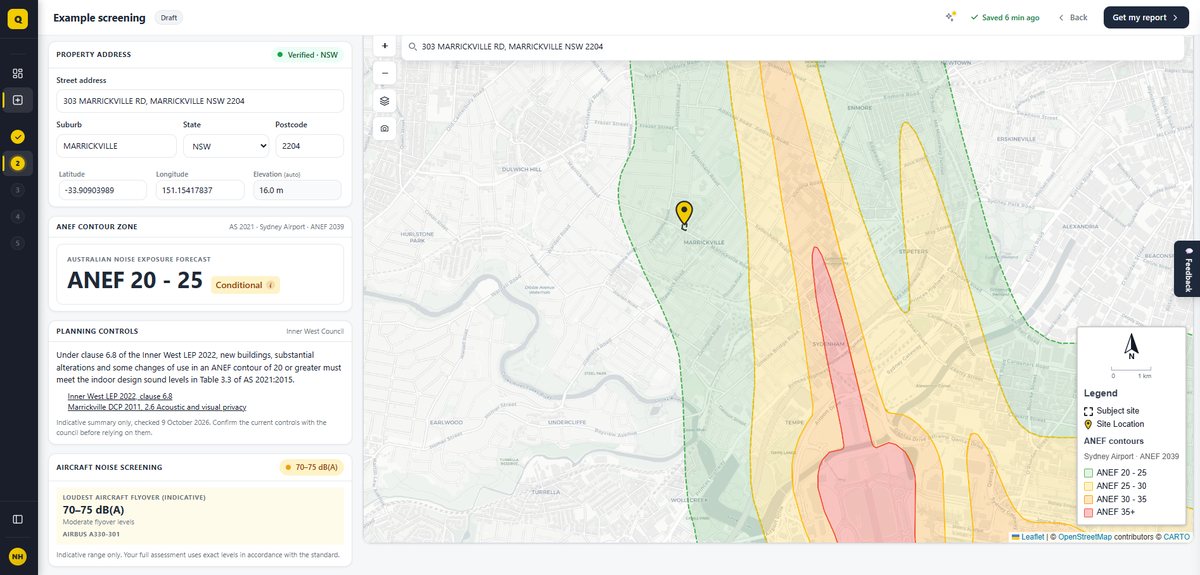
QuietPath's free address check shows the ANEF band and the classification for a new home. The full report sets it out against the standard's table and, where a site is in the unacceptable category, explains the provision for existing built-up areas.
Calculations
After the aircraft noise level is set, the report works out how much sound insulation each wall, window, door and roof needs. This depends on the room: its size, the area of glazing and whether it's a bedroom or a living area.
3 of the 20 reports included this calculation. Most gave one specification per room type, for example "bedrooms: 10.38 mm laminated glass", and many listed the rating of the product without the rating the room requires. Without the calculation it's hard to tell whether the specification is more than the building needs.
Where we could check the numbers, some reports specified more than the site called for. For example, a granny flat near a general aviation airport had a design noise level of 65 dB(A), which is low enough for ordinary construction to meet the standard. The report still required laminated glass with acoustic seals on every habitable window, a solid-core entry door with a drop seal, extra insulation in the walls and ceiling, and acoustic sealant to all gaps. By the standard's method, a typical bedroom window there needs a rating of about Rw 18. This can be easily achieved with standard 4 mm glass.
Other reports specified laminated glass, solid-core doors with seals or upgraded ceilings across the whole house, with no calculation to show which rooms needed them. Some of that may well have been needed. Without the numbers, though, the builder can't tell, or look for a cheaper way to comply. The standard assesses each room as a whole, so where the walls or ceiling already perform better than required, the windows may not need upgrading, or upgrading the ceiling may cost less than upgrading the glass.
A difference of a few decibels can change the glazing or roof specification, and the cost difference can be thousands of dollars.
QuietPath calculates the requirement for each element in each room from the floor plans and checks each room as a whole, so the specification matches what each room needs and the construction already allowed for counts towards it.
Aircraft noise levels
The design is based on the highest aircraft noise level expected at the site. The standard has tables of noise levels for each aircraft type at different distances from the runway, so the result depends on which aircraft are included.
Two house reports in the same suburb near Western Sydney International used different aircraft. One used a Boeing 747 at 78 dB(A) and the other a Boeing 737 at 73 dB(A). Neither said where its list of aircraft came from. At the second site the standard's tables give about 76.5 dB(A) for a Boeing 777, so the choice of aircraft changed the design level by several decibels.
Near a general aviation airport, two reports for almost the same location used 81 and 84 dB(A). The difference came from how each one handled a part of the standard's tables, close to the runway, that has no values for light aircraft. Neither report mentioned it.
Apart from the large planning studies for Sydney Airport, none of the 20 reports gave a source for its aircraft list.
QuietPath uses the aircraft list from the airport's master plan where one is available and lists the level for each aircraft type in the report. It checks every runway and uses the loudest, and it fills the gaps in the tables the same way each time, from the nearest values the standard gives.
Grey areas in the standard
Some of the differences between reports come from choices the standard leaves to the engineer, or from shortcuts it allows. Either is fine, but the report should say which was used.
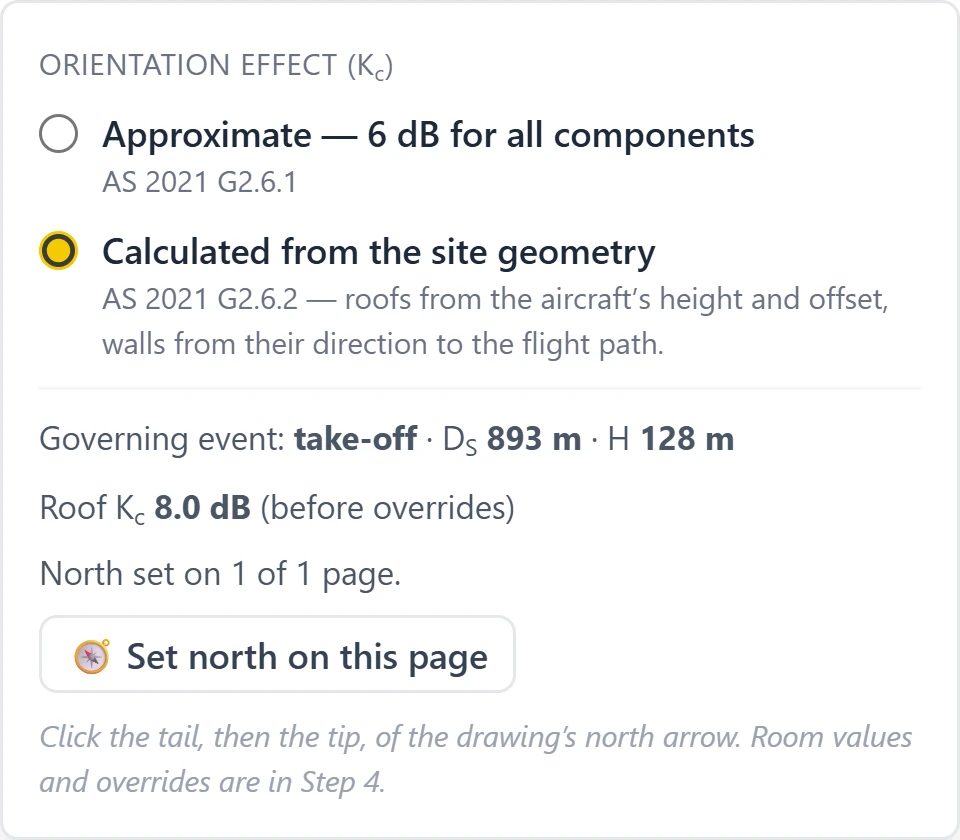
Orientation. A wall facing the flight path receives more noise than a wall facing away, and a roof directly under the flight path receives more than one to the side. The standard has a detailed method for this and a simpler approximation that applies the same allowance to every wall and roof. Most reports didn't show this step. Of those that did, most used the approximation and a few used the detailed method. Depending on the site, the approximation can understate the requirement for the roof, or for walls facing the flight path, by 4 to 6 decibels. It also overstates the requirement for walls facing away from the flight path, and for roofs on sites well to the side of it.
QuietPath also used the approximation until October 2026. The engineer can now select the detailed method, mark north on the plan, and QuietPath calculates each room's exposure from the direction its walls face. Rooms facing away from the flight path can then get a lighter specification.
Turning flight paths. Departing aircraft often turn soon after take-off, so a site some distance to the side of the runway can be under the flight path. The standard includes a method for curved flight paths. 3 of the 105 reports used it. We're adding it to QuietPath next.
Seals. One report specified mohair seals as acoustic seals. Another, for a house nearby, said mohair seals aren't acoustic seals. QuietPath specifies tested window and door systems with acoustic seals.
Ventilation
The indoor noise levels in the standard assume windows and doors are closed. Where they need to be closed to meet those levels, the rooms need another source of fresh air, usually mechanical ventilation or air conditioning.
Of the 18 reports that required upgraded construction, 10 didn't mention ventilation. Every QuietPath report includes it.
Copy-and-paste errors
More than half of the 20 reports had text left over from other projects, including "apartments" in a report for a single house, railway noise in an aircraft noise report, a reference to a recommendations section that wasn't there, runway names swapped in a figure, and a draft note left in the document.
A QuietPath report is generated from the assessment data, so the address, building details and runway come from the same source as the calculations. Each report is prepared by a Resonate acoustic engineer.
What to look for in your report
If you have an aircraft noise report for your project, these are worth checking:
- Does it state the site's ANEF band and how the standard classes the site for your type of building?
- Does it say which aircraft it designed for, and where that list came from?
- Are the requirements worked out room by room, or is it one specification for every bedroom? A blanket specification often means paying for treatment some rooms don't need.
- Does it say how the rooms will be ventilated with the windows closed?
If any of these are missing, ask your consultant before the report goes to council.
Sources
- 105 aircraft noise reports lodged with development applications and planning proposals, published on the NSW Planning Portal and on council and state planning sites in NSW, Queensland and Western Australia. Reviewed October 2026.
- Standards Australia, AS 2021:2015 Acoustics—Aircraft noise intrusion—Building siting and construction. Available from Standards Australia.