What is AS 2021? The aircraft noise standard, explained
AS 2021 is the Australian Standard that councils point to when someone wants to build near an airport. Its full title is AS 2021:2015 Acoustics—Aircraft noise intrusion—Building siting and construction. If your council has asked for an aircraft noise report, this is almost certainly the standard it will be written to.
The standard answers two questions. Is this site suitable for this kind of building, given how much aircraft noise it gets? And if it is, how well does the building need to keep that noise out? This guide walks through both, without the jargon where we can avoid it.
Where AS 2021 comes from
AS 2021 is published by Standards Australia. The current edition came out in 2015 and replaced the 2000 edition. It was written by the committee responsible for aircraft and helicopter noise standards, and it's built around the ANEF system, the forecast noise maps produced for most Australian airports (we explain those in What is ANEF?).
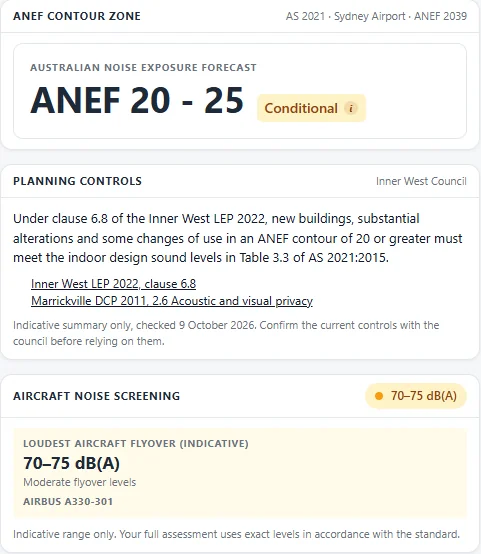
On its own, a standard is guidance. It becomes a requirement when a planning rule calls it up. In NSW that's usually a clause in the council's local environmental plan (LEP) that applies inside the ANEF 20 contour, backed up by more detail in the development control plan (DCP). Some LEPs still refer to the 2000 edition and some to the 2015 edition, so check which one your council's clause names. Our guide When do I need an aircraft noise assessment? lists the rules council by council.
Step one: is the site acceptable?
The first part of the standard compares the ANEF zone a site sits in with the type of building proposed. Table 2.1 of AS 2021 sorts each combination into one of three outcomes.
- Acceptable. No special construction for aircraft noise is usually needed. The standard is careful to say this doesn't mean aircraft noise won't be noticed.
- Conditionally acceptable. The building can go ahead if it's designed to reduce aircraft noise to set indoor levels. This is where an aircraft noise report earns its keep.
- Unacceptable. The standard doesn't recommend new building of that type there.
Here's how Table 2.1 sorts the main building types. The ANEF numbers refer to the contour bands on the airport's ANEF chart.
| Building type | Acceptable | Conditionally acceptable | Unacceptable |
|---|---|---|---|
| House, home unit, flat, caravan park | Below ANEF 20 | ANEF 20 to 25 | Above ANEF 25 |
| Hotel, motel, hostel | Below ANEF 25 | ANEF 25 to 30 | Above ANEF 30 |
| School, university | Below ANEF 20 | ANEF 20 to 25 | Above ANEF 25 |
| Hospital, nursing home | Below ANEF 20 | ANEF 20 to 25 | Above ANEF 25 |
| Public building | Below ANEF 20 | ANEF 20 to 30 | Above ANEF 30 |
| Commercial building | Below ANEF 25 | ANEF 25 to 35 | Above ANEF 35 |
| Light industrial | Below ANEF 30 | ANEF 30 to 40 | Above ANEF 40 |
| Other industrial | Acceptable in all ANEF zones | ||
The notes under the table matter as much as the table itself:
- The ANEF 20 line is hard to pin down because real flight paths vary, so the standard allows the conditionally acceptable process to be used for sites just outside it. Some councils, such as Bayside and Randwick, apply their aircraft noise controls to sites near the line as well as inside it.
- Between ANEF 20 and 25, the standard notes that some people will find the land isn't compatible with homes or schools, and that councils may require noise control in the construction.
- In unacceptable areas, the standard doesn't recommend development. Where a council decides development has to happen in an existing built-up area anyway, the standard recommends the building still achieve the noise reduction worked out in Section 3, and that the effect of noise on outdoor areas be considered for homes and schools.
- New development should never go on greenfield land that is unacceptable, because it could affect how the airport operates.
Around Sydney Airport, thousands of established homes sit in ANEF 25 and above; more than 4,000 in the noisiest areas were insulated under a federal program in the 1990s and 2000s. Councils there regularly deal with alterations, additions and rebuilds in zones the table calls unacceptable, which is why most of their rules focus on meeting indoor noise levels rather than refusing everything.
Step two: how much noise does the building need to block?
For a conditionally acceptable site, Section 3 of AS 2021 works out how much the building has to reduce aircraft noise. It does this in three moves.
1. Work out how loud the aircraft will be at the site
The standard has a large set of noise tables (Tables 3.4 to 3.58), one for each aircraft type's arrivals and departures. You find the aircraft forecast to use each runway, measure the site's distances from each runway and its extended centreline, and read off the expected maximum noise level for each aircraft. The highest typical value becomes the design noise level for the site. Large differences in ground height between the site and the airport are corrected for.
2. Pick the indoor target for each room
Table 3.3 sets an indoor design sound level for each type of space: the loudest an aircraft flyover should be inside. For homes, the targets are:
| Room | Indoor design sound level |
|---|---|
| Sleeping areas, dedicated lounges | 50 dB(A) |
| Other habitable spaces (living, dining, kitchen, study) | 55 dB(A) |
| Bathrooms, toilets, laundries | 60 dB(A) |
Table 3.3 also covers hotels, schools, hospitals, public buildings, offices, shops and industrial spaces. Councils can set their own indoor levels instead, though in NSW the LEP clauses generally point straight to Table 3.3.
3. Take the difference
The gap between the two is the aircraft noise reduction, or ANR, that the building envelope has to provide. If the loudest typical aircraft at the site is 80 dB(A), a bedroom needs an ANR of 30 dB, a living room 25 dB and a bathroom 20 dB. Each room is worked out separately because each has its own target and its own mix of walls, windows and roof.
Where a room needs more than 30 dB of reduction, the standard recommends looking at the noise frequency by frequency rather than as a single number. Jet noise close to an airport is heavy in low frequencies, and those are the hardest to keep out.
Step three: choosing the construction
Once the ANR for each room is known, the design has to achieve it. Clause 3.3 of the standard and its appendices cover this. A few points shape almost every design:
- Windows and doors are assumed shut. The construction only works with them closed. If they need to be closed to meet the standard, the building's ventilation should be designed as if they can't be opened, with mechanical ventilation or air conditioning complying with AS 1668.2.
- Every element counts. Appendix G of AS 2021 gives one method for choosing constructions. It treats each room's roof and ceiling, external walls, windows and external doors as separate paths for noise, and sets a performance for each so that no single path lets in more than its share.
- Lab ratings flatter real buildings. Appendix F warns that sound insulation ratings (Rw) come from laboratory tests, and real installations do worse, especially when detailing or workmanship is poor. Higher-rated products lose more to small gaps.
In practice the upgrades are things like thicker laminated or double glazing, acoustic seals on doors and windows, extra plasterboard and insulation in the ceiling, and ducted ventilation. Our guide to noise attenuation for homes under flight paths goes through the options element by element.
Testing after construction
Clause 3.4 and Appendix D describe how to measure the noise reduction a finished building actually achieves. If the measured ANR is at least the design ANR, the building complies. Testing isn't routine for most houses, but a council or certifier can ask for it.
What AS 2021 doesn't cover
- Outdoor spaces. The standard deals with noise inside buildings. Backyards, balconies and playgrounds aren't assessed.
- How annoying aircraft noise is. The standard is a design tool, not a measure of annoyance. Its foreword notes that some people will be seriously disturbed by aircraft noise even in a building that meets it, and that communities newly exposed to aircraft noise tend to react more strongly than those used to it.
- Helicopters. The noise tables can't be used for helicopters, and the standard recommends expert advice where they may cause the loudest events.
- Small airfields without an ANEF. Appendix E gives a separate method for light general aviation aerodromes that have no ANEF chart.
AS 2021 is also easy to confuse with AS/NZS 2107, which sets recommended background noise levels inside buildings, and with South Australia's Ministerial Building Standard MBS 010, which covers aircraft, road and rail noise in that state.
What this means for your project
If your site is inside an ANEF 20 contour, or close to one, expect council to ask for a report showing the design meets the indoor levels in Table 3.3. The report sets out the noise level at the site, the reduction each room needs, and the rating each window, door, wall and roof or ceiling has to achieve. If the drawings fall short, it says what has to change.
It's cheaper to sort this out early. Window sizes, roof form and where the bedrooms go all affect how hard the standard is to meet, and changing them after the DA drawings are done costs time.
Sources
- Standards Australia, AS 2021:2015 Acoustics—Aircraft noise intrusion—Building siting and construction. Available from Standards Australia.