Building near Sydney Airport: what you need to know
Thousands of homes sit under Sydney Airport's flight paths, from the inner west to the shores of Botany Bay. If you're building, extending or knocking down and rebuilding in one of these suburbs, council will probably want to see that the design keeps aircraft noise out.
The airport and its runways
Sydney (Kingsford Smith) Airport has three runways:
- 16R/34L, the main north-south runway, 3,962 m long
- 16L/34R, the shorter parallel runway, opened in 1994 and 2,438 m long
- 07/25, the east-west runway
The two parallel runways send most traffic north over the inner west and south over Botany Bay. The east-west runway brings aircraft over the eastern suburbs and the area west of the airport, mostly when the wind requires it or when it's used to share noise around.
Since 1997, runway use has been managed under the Long Term Operating Plan, which Airservices Australia administers. It aims to send as many flights as possible over water and to spread the rest across the different flight paths, so no single area gets it all. In practice that means the flight paths over a given suburb change from day to day and even within a day.
Sydney Airport's ANEF
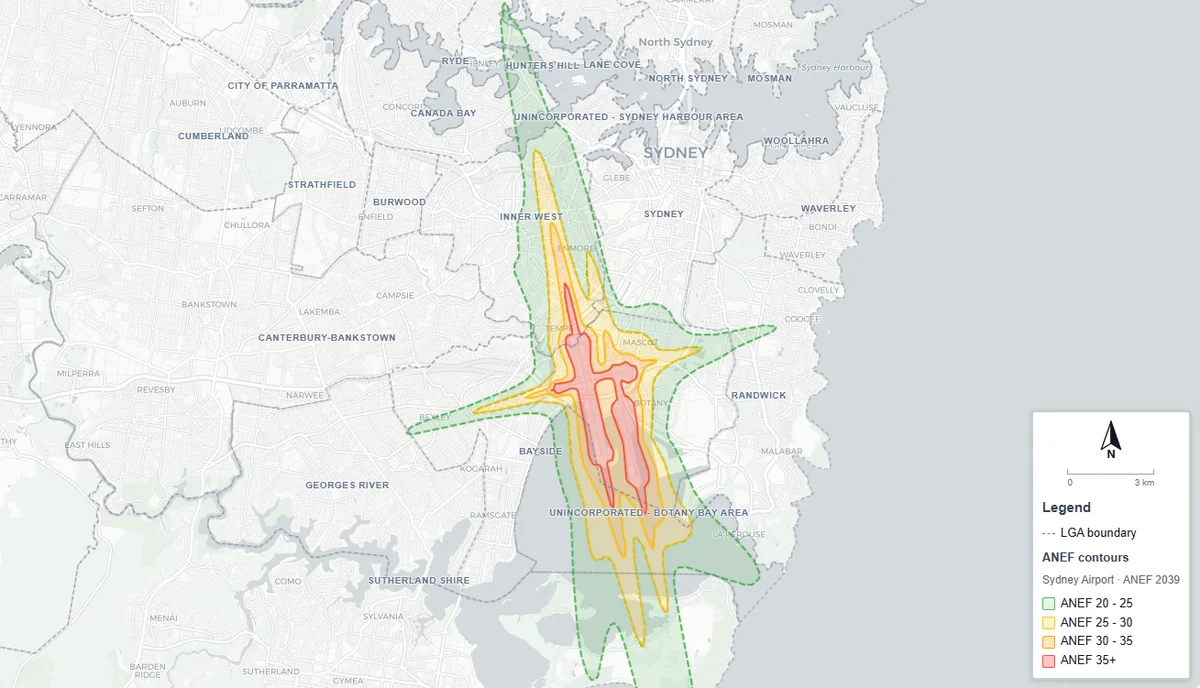
The ANEF (Australian Noise Exposure Forecast) is the official noise map councils use to apply their aircraft noise rules. Sydney Airport has to produce a new master plan every five years, each with an updated ANEF, so the contours shift over time as flight numbers, aircraft types and runway use change. The current ANEF is in the airport's latest master plan.
Councils update their own maps and documents at different times after a new ANEF comes out. If your site is close to a contour line, ask the council which ANEF it's applying.
Council rules around Sydney Airport
Most councils around the airport have a clause in their local environmental plan that applies in ANEF 20 and above. It requires new homes, and in most cases substantial alterations and additions, to meet the indoor noise levels in the Australian Standard for building near airports, AS 2021. The council areas involved are Inner West, Bayside, City of Sydney, Randwick, Canada Bay, Georges River and Sutherland Shire. Canterbury-Bankstown, Hunters Hill and Lane Cove have no clause for Sydney Airport.
The main differences:
- Bayside has the most detailed controls. Its DCP requires a Noise Impact Assessment in ANEF 20 and above, treats sites on or next to a contour line as inside it, says homes, schools and hospitals aren't to be located in ANEF 30 and above, and requires outdoor areas such as decks to be considered in ANEF 25 and above.
- Sutherland Shire is the strictest. In ANEF 25 and above it prohibits dual occupancies, secondary dwellings, multi dwelling housing, seniors housing and several other uses.
- Randwick requires noise attenuation recommended by a qualified acoustic consultant and encourages a pre-lodgement meeting for new dwellings and substantial alterations.
- Inner West still uses the DCPs of its former councils. In the old Leichhardt area, a new dwelling exposed to aircraft noise needs an acoustic report with the DA.
Complying development (CDC) is limited too. Under the state Codes SEPP, a new house or addition in ANEF 20–25 can be complying development only if it's built to AS 2021:2015, and in ANEF 25 and above, new homes need a full development application. Our council-by-council guide has the detail and links for each council.
The curfew
Under the Sydney Airport Curfew Act 1995, the curfew runs from 11 pm to 6 am. Only a limited set of flights can operate during it, such as emergencies and flights given a dispensation, and they must operate over Botany Bay. A small number of landings are allowed between 5 am and 6 am.
The Act's exceptions for some freight flights and small, quieter aircraft stop applying once Western Sydney International, which has no curfew, is open for night operations, so overnight freight goes there instead.
Living outside the curfew hours is a different matter. Flights start at 6 am and run until 11 pm, so if you're designing a bedroom on a busy flight path, plan for early-morning and late-evening flights.
The movement cap
The Sydney Airport Demand Management Act 1997 caps aircraft movements at 80 in any hour, measured over rolling 15-minute starts. Since 26 October 2025, the Minister can declare a recovery period after disruptions like fog or storms, allowing up to 85 movements an hour for up to two consecutive hours. The daily total doesn't increase.
The old noise insulation program
From 1994 to the early 2000s, the Australian Government's noise amelioration program insulated homes and public buildings in the noisiest areas around Sydney Airport, funded by a levy on jet aircraft. According to Sydney Airport's master plan, 4,083 homes and 99 public buildings were insulated, and 147 homes were bought and removed to create Sydenham Green. The treatments included heavy roof insulation membranes, laminated glass from 6.38 mm to 10.38 mm thick, and secondary windows.
That program is long finished, and there's no insulation program open for Sydney Airport today. If you're building or renovating near the airport, the noise insulation is part of your project and your budget. Our guide to noise attenuation for homes under flight paths covers what's usually involved. The only government insulation program currently running in the Sydney region is for homes near Western Sydney International.
Where to find noise information
- Live and past flights: Airservices' WebTrak for Sydney shows flight tracks, aircraft heights and noise monitor readings.
- Noise maps and history: Airservices' Aircraft in Your Neighbourhood portal.
- How often planes are loud: the airport's master plan includes N70 contours, showing the number of flights a day above 70 dB(A). Our guide ANEF vs N70 explains them.
- Questions and complaints: Airservices' Noise Complaints and Information Service, 1800 802 584 (10 am to 4 pm, Sydney time). If you're unhappy with how a complaint was handled, the Aircraft Noise Ombudsman can review it.
- Community consultation: the Sydney Airport Community Forum is the main forum on the Long Term Operating Plan.
What this means for your project
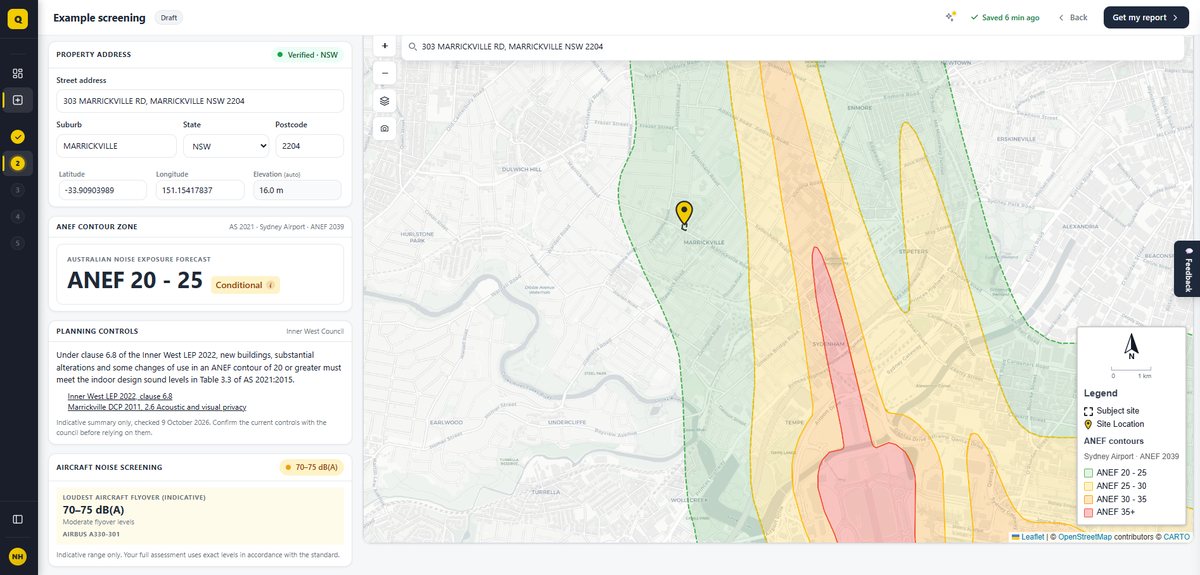
If your site is inside the ANEF 20 contour, or close to it, plan on an aircraft noise report for your DA or CDC. It sets out the aircraft noise level at your site, how much each room needs to reduce it, and the minimum rating for each window, door, wall and ceiling. Getting it early, before the design is fixed, usually saves money: window sizes, roof form and where the bedrooms go all make a difference.
QuietPath's free check shows your site's contour band and council rules, plus an indicative range for the loudest aircraft flyover. When you need the report, upload your drawings and a Resonate acoustic engineer prepares it in days.
Sources
- Sydney Airport, master plan.
- Department of Infrastructure, Sydney Airport curfew and demand management.
- Prime Minister of Australia, Western Sydney to open for passengers on 25 October, 10 June 2026.
- Australian National Audit Office, Sydney Airport Noise Amelioration Program, 1997.
- NSW local environmental plans, legislation.nsw.gov.au, checked October 2026.