When do I need an MBS 010 assessment? Building near busy roads, trains and airports in South Australia
If you're building or extending a home in South Australia near a busy road, a train or tram line, or one of Adelaide's airports, your plans may need to show they keep outside noise to a reasonable level indoors. The rules for that are called MBS 010. This guide explains how to tell whether they apply to you, what they mean for your build, and how to get them dealt with.
Does it apply to my site?
Three things decide it.
1. Is your property on the state's noise map?
South Australia's planning rules mark out the areas where outside noise needs to be designed for. There are two maps:
- land along busy roads and train and tram lines, and in mixed-use areas where homes sit among shops, cafés and bars
- land around Adelaide Airport, Parafield Airport and RAAF Base Edinburgh that gets a meaningful amount of aircraft noise
If your property is on neither map, MBS 010 doesn't apply and you can stop here. The free check above reads both maps for you. If you'd rather look yourself, they're the Noise and Air Emissions Overlay and the Aircraft Noise Exposure Overlay in the SA Property and Planning Atlas.
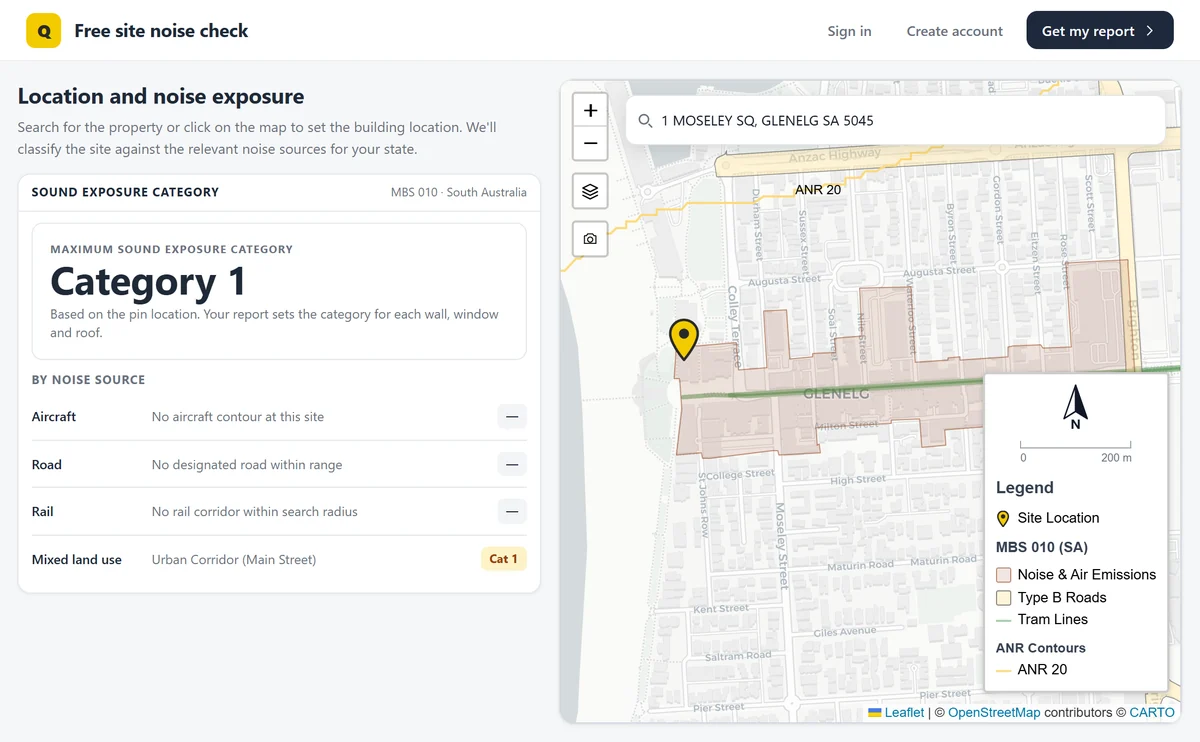
2. How close is the noise?
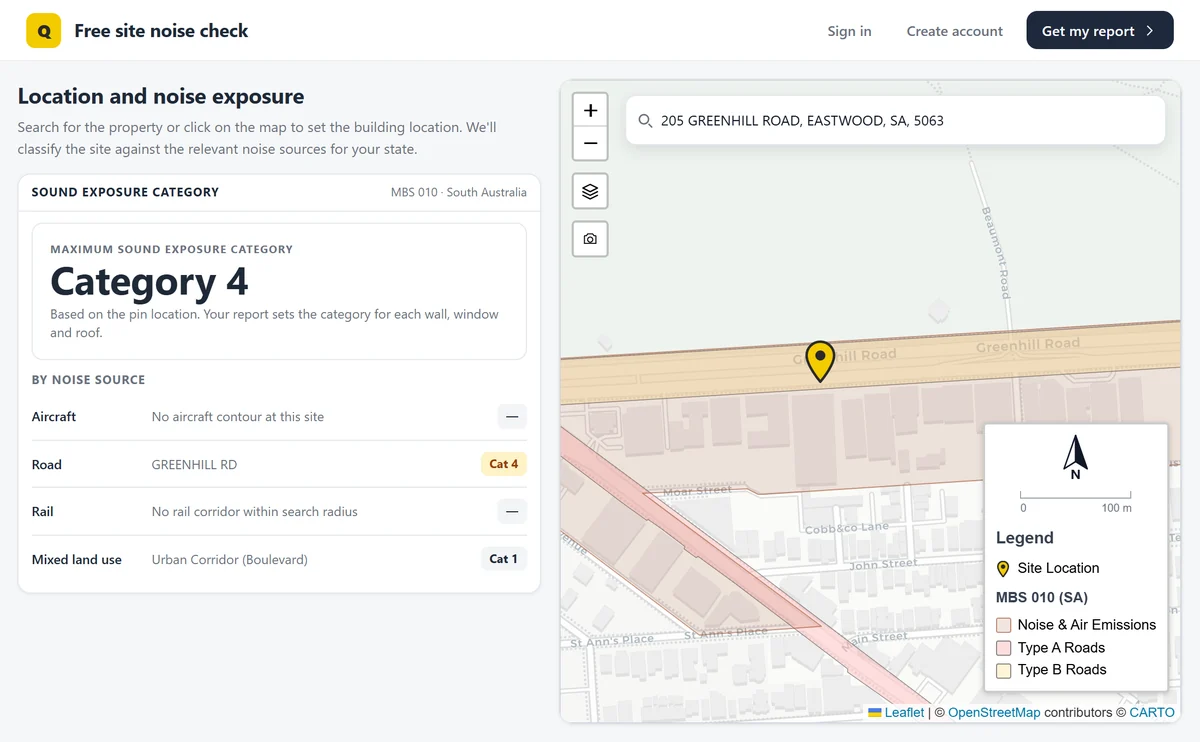
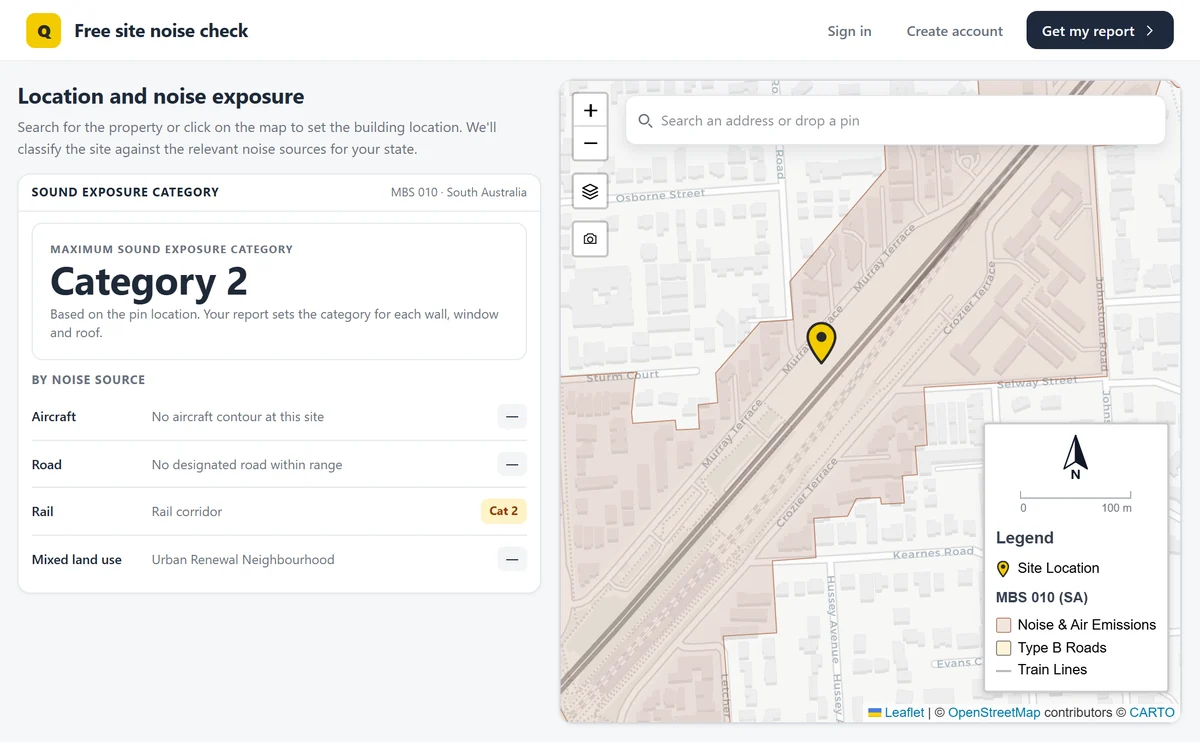
Being on the map doesn't always mean you'll need to change anything. The rules only kick in within a certain distance of the noise source, and that distance depends on how busy the road is and its speed limit. As a rough guide:
- The busiest main roads: within about 100 m on a 60 km/h road, and up to 200 m where the limit is 100 km/h or more
- Other main roads: within about 35 to 130 m, depending on the road and its speed limit
- Train lines: within 50 m
- Tram lines: within 20 m
- Aircraft: it depends on how much aircraft noise is mapped at your address. Some homes inside the airport noise contours turn out to need nothing.
- Mixed-use areas: modest upgrades apply across the whole home, wherever it sits on the block
The closer the home is, the more it needs. A house a few metres back from a main road needs a lot more than one at the far end of a deep block.
3. Are you building somewhere people will live?
MBS 010 is about the rooms people live and sleep in. It usually comes up for:
- a new home, including a knock-down rebuild
- townhouses, units and apartments
- a granny flat
- an extension that adds or changes a bedroom, living area or study (check with your building certifier how they'll apply it to an extension)
- aged care, boarding houses and short-term accommodation
A garage, carport, deck, pool or a bathroom on its own isn't affected.
What it means for your build
MBS 010 doesn't stop you building. It sets a minimum standard for how well the outside of the home keeps noise out, and that standard rises the closer you are to the source. In practice that usually means:
- Better windows on the noisy side: thicker or laminated glass and proper seals. This is normally the biggest change.
- Smaller or fewer large glass doors facing the noise, especially in bedrooms. In the highest sound exposure categories, glass doors aren't allowed in bedrooms when using the standard's ready-made deemed-to-satisfy provisions. An engineered performance solution might be able to show a glass door is allowed, but it will typically require thick and expensive acoustic glass.
- Heavier walls and better-insulated ceilings for the most exposed rooms.
- Ducted ventilation or air conditioning on the most exposed sites, so the home stays comfortable with the windows shut.
The side of the house facing the noise needs the most. Walls facing away from it usually need less. That's why layout matters: putting bedrooms at the back, and keeping big windows on the quiet side, can save real money. It's much cheaper to sort out at design stage than after the plans are drawn.
Where it comes up in the approval process
Most building work in South Australia needs two approvals, and noise can come up at both.
- Planning consent. If your home will sit right next to a busy road or rail line, or in the noisiest areas near the airport, the planning assessment looks at how the design deals with it: where the bedrooms and outdoor areas are, and whether anything shields them. Council may ask for an acoustic report at this stage.
- Building rules consent. This is where MBS 010 itself is checked. Your building certifier or council will want to see that the windows, doors, walls, roof and ventilation meet it.
Do I need an acoustic report?
Not always. MBS 010 includes ready-made tables, and on a straightforward site a building designer who knows them can work out the requirements without a report. The government's own guide to MBS 010 says as much.
In practice, most people get one, because:
- Their designer or builder would rather not take responsibility for the noise side, or doesn't use the standard often.
- The home faces more than one noise source, or different sides need different treatment.
- The design has big windows or sliding doors facing the road.
- The site is close enough to a busy road that the ready-made tables don't cover it, so an acoustic engineer has to design the solution.
- They want to avoid paying for more than they need. The ready-made tables are deliberately cautious, as the next section explains.
- Council has already asked for one.
Why an engineered solution is often worth it
For road and rail noise, an acoustic engineer can design to the site instead of using the ready-made tables. The standard calls this a performance solution, and the government's guide to MBS 010 notes it can cut construction costs significantly.
- It counts what shelters the home. The ready-made tables only allow for shelter in a simple yes-or-no way. An engineer works out how much nearby buildings, fences, noise walls and the lie of the land actually cut the noise at each wall. That often reduces what the walls, windows and roof need.
- It usually costs less overall. The consulting fee for a performance solution might be a few thousand dollars more than for the ready-made route, but the saving in construction can be tens of thousands, even for a single home or a small development.
- It works with the cladding you want. MBS 010 lists only a few accepted wall constructions. Many builders and designers prefer cladding that isn't on the list and has no tested acoustic rating. An engineer can calculate how it will perform using established modelling methods, or by comparing it with similar tested systems.
Does noise need to be measured or monitored on site?
No. MBS 010 doesn't require it, and it doesn't provide for it either. The standard is designed to be applied as a desktop assessment, from the plans and the state's maps, with no site visit to measure or monitor noise. The road and rail noise levels it assumes allow for traffic growing over time, so designing the insulation around the noise measured today would go against what the standard intends.
Some common situations
Knocking down and rebuilding on a main road. The front rooms will usually need upgraded windows, ceilings and ventilation, and the side and rear walls less. Moving the main bedroom to the back is often the cheapest fix.
Townhouses near a train line. The units nearest the line need the most. Units sheltered behind another building may need little or nothing for train noise.
An apartment in a mixed-use area. Every room gets a modest upgrade, with more on any side facing a busy road.
A home near Adelaide Airport. Aircraft noise comes from above, so the roof and ceilings matter as much as the windows. The requirements depend on the exact address, and neighbouring streets can differ.
A granny flat or extension. A granny flat is treated like a new home. For an extension with new bedrooms or living areas, your certifier will tell you how they'll apply the rules.
How QuietPath helps
You upload your plans (site plan, floor plans and elevations; a window and door schedule helps) and confirm the address. A Resonate acoustic engineer works out what applies to your site, marks up the drawings to show what each side of the home needs, and lists the window, door, wall, ceiling and ventilation requirements. If the design as drawn falls short, the report says what has to change. Our guide to noise attenuation for homes explains the usual upgrades. Approving the development is always up to the council or your building certifier.
If you'd like the technical detail behind all this, What is MBS 010? goes through how the standard works.
Sources
- Minister for Planning (SA), Ministerial Building Standard MBS 010 Construction requirements for the control of external sound, May 2023 (Version 3), sections 1 to 5. Available from PlanSA.
- Government of South Australia, Applying the MBS 010 Construction requirements for the control of external sound: guide for relevant authorities and applicants, Version 1.0, August 2021.
- South Australian Planning and Design Code, Noise and Air Emissions Overlay and Aircraft Noise Exposure Overlay.
- SA Property and Planning Atlas (SAPPA), designated road, rail corridor and ANR layers.