What is MBS 010? South Australia's rules for keeping road, rail and aircraft noise out of homes
MBS 010 is the South Australian building standard for homes near busy roads, train and tram lines and airports, and in lively mixed-use areas. It sets how well the outside of a home has to keep that noise out. This guide explains what it is and how it works in plain English, so you know what to expect before you build.
Where MBS 010 comes from
MBS 010 is short for Ministerial Building Standard MBS 010 Construction requirements for the control of external sound. It's published by South Australia's Minister for Planning and forms part of the state's Building Rules, so where it applies, it's compulsory rather than optional advice. It sits on top of the National Construction Code rather than replacing it. The current version is dated May 2023, and the standard and the government's guide to it are both free to download from PlanSA.
It only applies in areas the state's planning maps mark as affected by noise. Our guide When do I need an MBS 010 assessment? explains how to tell whether your property is one of them.
What it covers
MBS 010 applies to homes of every kind: houses, townhouses, units and apartments, granny flats, boarding houses, short-term accommodation and aged care.
Within a home, it only cares about the rooms people live and sleep in: bedrooms, living and dining areas, studies and the like. Bathrooms, laundries, garages and enclosed kitchens don't count. An open-plan kitchen is treated as part of the living area it opens onto.
It deals with four kinds of noise:
- Busy roads, mainly the freight and main traffic routes the state has mapped
- Train and tram lines
- Aircraft around Adelaide Airport, Parafield Airport and RAAF Base Edinburgh
- Mixed-use areas, where shops, cafés and bars sit alongside homes and the noise could come from any direction
What it's aiming for
The goal is simple: keep noise inside the home down to an acceptable level. Bedrooms have the strictest target, then living areas. For road and rail noise, the targets are about the noise level through the night, between 10 pm and 7 am. For aircraft, they're about the loudest flyover, using the same indoor targets as AS 2021, the Australian Standard used for aircraft noise in other states.
You don't need to measure anything to meet these targets. The standard turns them into a set of ready-made building requirements, explained below.
How it works: a noise level for each side of the home
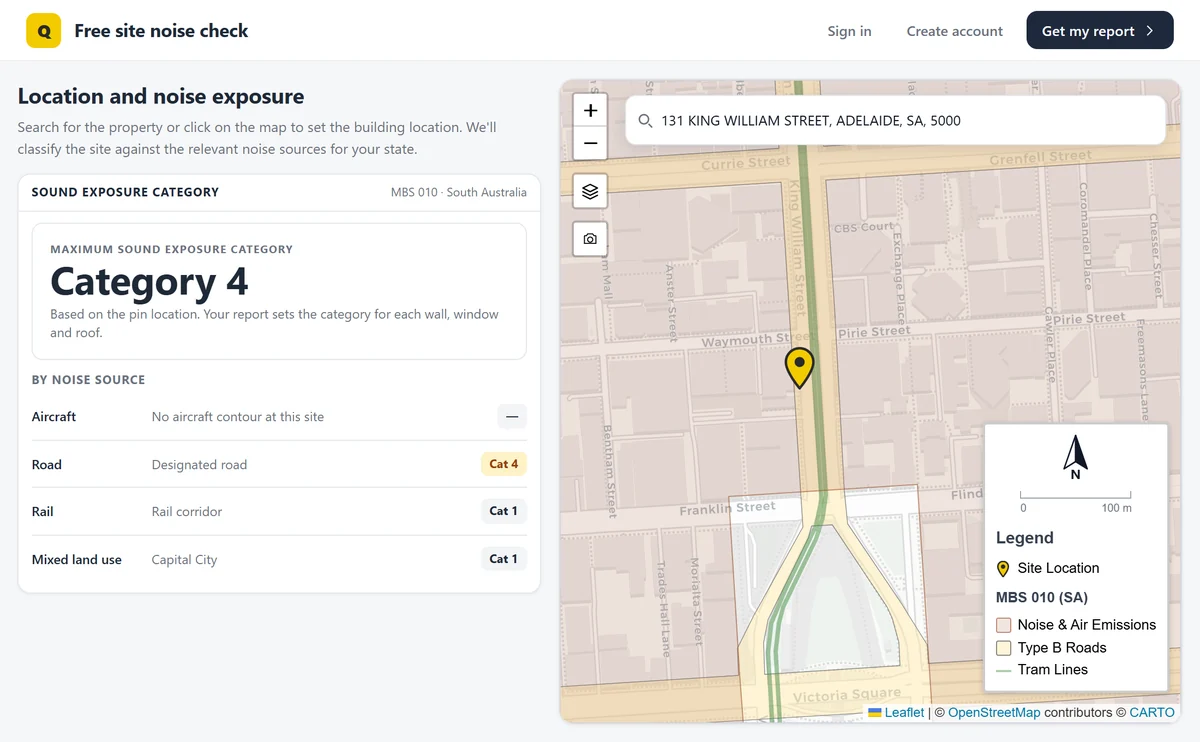
The heart of MBS 010 is a rating from 1 to 5 for how exposed each side of the home is to noise. The standard calls it the sound exposure category. Level 1 needs modest upgrades, level 4 needs substantial ones, and level 5 is too exposed for the standard's ready-made requirements, so an acoustic engineer has to design the solution.
What sets the level:
- For roads, how busy the road is, its speed limit, and the distance to the nearest wall of a bedroom or living space. A garage at the front doesn't count.
- For train and tram lines, the distance to the nearest track.
- For aircraft, a figure the state has mapped for every address in the airport noise areas. Two homes a few streets apart can land on different levels.
- In mixed-use areas, every side of the home is level 1.
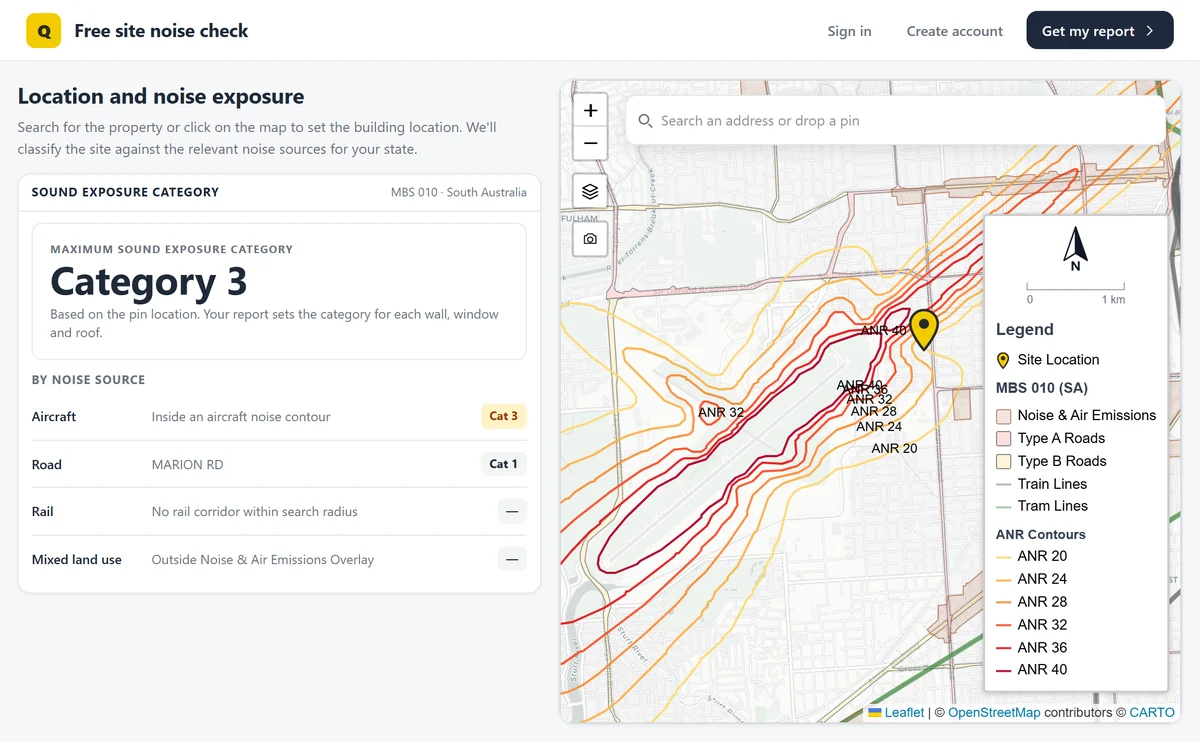
Each side of the home is rated separately, so the front of a house facing a main road might be level 4 while the sides and back are lower. A wall that can't "see" the road, because the house itself, another building or a noise wall is in the way, either drops a level or doesn't count as exposed at all. If a home is near two noise sources, the worse one applies.
What changes at each level
The higher the level, the more the outside of the home has to do. Broadly:
| Level | What it usually means |
|---|---|
| 1 | Upgraded windows and external walls, and quieter ventilation openings. |
| 2 | Better windows and walls again, solid external doors with seals, and a better ceiling over bedrooms. |
| 3 | Heavier walls, thicker glass, and better ceilings over all bedrooms and living areas. |
| 4 | The heaviest walls and ceilings, laminated glass, and ducted ventilation so the home works with the windows shut. Glass doors aren't allowed in bedrooms when using the standard's ready-made deemed-to-satisfy provisions. An engineered performance solution might be able to show a glass door is allowed, but it will typically require thick and expensive acoustic glass. |
| 5 | Too exposed for the ready-made requirements. An acoustic engineer designs the solution. |
A few things catch people out:
- Glass is the weak point. The bigger the windows and glass doors in a room, the better each one has to be. Large sliding doors facing a main road get expensive quickly, and a lot of glass at the higher levels takes you outside the ready-made requirements altogether.
- Seals matter. Opening windows and doors need proper seals. Brush seals don't count.
- Ensuites and walk-in robes. If one sits on the noisy side next to a bedroom, it either needs a solid wall and door between them or has to be built to the bedroom's standard.
- Raked ceilings. Cathedral-style ceilings struggle to meet the requirements for the most exposed bedrooms unless they're built on a separate frame.
- Gaps. Every pipe and duct through an outside wall has to be sealed airtight, or it undoes the rest of the work.
Our guide to noise attenuation for homes goes through the usual upgrades in more detail. It's written for aircraft noise, but most of it applies to road and rail noise too.
Two ways to comply
The ready-made route. MBS 010 includes tables of minimum ratings for windows, doors, walls, roofs and ventilation at each level, plus building methods that are accepted as meeting them. A designer who knows the standard can apply these without an acoustic report. The catch is that the tables are deliberately cautious, so they can ask for more than your site really needs.
The engineered route. An acoustic engineer models the actual site and works out what's really needed. The standard calls this a performance solution. It's required at level 5 or with a lot of glass at the higher levels. For road and rail noise it's often worth doing anyway, and the government's guide to MBS 010 notes it can cut construction costs significantly:
- It counts what shelters the home. The ready-made tables only allow for shelter in a simple yes-or-no way. An engineer works out how much nearby buildings, fences, noise walls and the lie of the land actually cut the noise at each wall. That often reduces what the walls, windows and roof need.
- It usually costs less overall. The consulting fee for a performance solution might be a few thousand dollars more than for the ready-made route, but the saving in construction can be tens of thousands, even for a single home or a small development.
- It works with the cladding you want. MBS 010 lists only a few accepted wall constructions. Many builders and designers prefer cladding that isn't on the list and has no tested acoustic rating. An engineer can calculate how it will perform using established modelling methods, or by comparing it with similar tested systems.
Does noise need to be measured or monitored on site?
No. MBS 010 doesn't require it, and it doesn't provide for it either. The standard is designed to be applied as a desktop assessment, from the plans and the state's maps, with no site visit to measure or monitor noise. The road and rail noise levels it assumes allow for traffic growing over time, so designing the insulation around the noise measured today would go against what the standard intends.
What MBS 010 doesn't cover
- Outdoor spaces. Yards and balconies are dealt with at the planning stage, not by MBS 010.
- Vibration. Homes within about 10 m of a road or 20 m of a rail line may feel ground vibration. The standard doesn't deal with it and recommends advice from an acoustic engineer.
- Combined noise. It looks at the worst single source, not road, rail and aircraft noise added together.
- Non-residential buildings. Offices, shops and schools are outside its scope.
- A particular noisy neighbour. Noise from a specific venue playing music is handled separately in the planning rules.
Outside South Australia, aircraft noise near homes is usually dealt with under AS 2021. In South Australia, MBS 010 takes that role for homes, though acoustic engineers may still refer to AS 2021 when designing an engineered solution. Our guide What is AS 2021? explains that standard.
What this means for your project
If MBS 010 applies to your site, your building approval will need to show that the windows, doors, walls, roof and ventilation meet it. If the plans fall short, something has to change before approval.
It's much cheaper to think about this at design stage. Putting bedrooms on the quiet side, keeping big windows away from the road, and using the house itself to shelter the backyard all reduce what you'll need to spend. Changing them after the plans are drawn costs time and money.
Sources
- Minister for Planning (SA), Ministerial Building Standard MBS 010 Construction requirements for the control of external sound, May 2023 (Version 3), sections 1 to 5 and Appendix A. Available from PlanSA.
- Government of South Australia, Applying the MBS 010 Construction requirements for the control of external sound: guide for relevant authorities and applicants, Version 1.0, August 2021.
- South Australian Planning and Design Code, Noise and Air Emissions Overlay and Aircraft Noise Exposure Overlay.