Complying development near NSW airports: a guide for certifiers
Complying development is everyday work near airports in NSW. Around Sydney Airport alone, going by the NSW Planning Portal, roughly 150 complying development certificates (CDCs) a year are issued for new houses and house extensions inside the ANEF 20 to 25 band. State Environmental Planning Policy (Exempt and Complying Development Codes) 2008 (the Codes SEPP) contains aircraft noise rules which are the same near every airport in the state that has an ANEF, from Sydney and Newcastle to regional airports and RAAF bases. This guide covers how they work, a checklist for CDCs, and what Sydney Airport's new ANEF 2045 changes.
Western Sydney International is different. Around the new airport, the Western Parkland City SEPP stops most new homes on land in an ANEF or ANEC contour of 20 or more, and its contours allow for a future second runway. This guide doesn't cover it. See Building near Western Sydney International.
The Codes SEPP clauses
Two clauses in the Codes SEPP deal with aircraft noise. Both work off the airport's current ANEF.
- ANEF 20 to 25: clause 1.18(2). A new dwelling house, or an addition to one, is complying development only if it's constructed in accordance with AS 2021:2015, the Australian Standard for building near airports.
- ANEF 25 and above: clause 1.19(1)(h). Complying development under the Housing Code and the related housing codes can't be carried out on the land, unless the work is only ancillary, attached or detached development, such as a deck, patio, garage, shed, studio or pool. A new house, granny flat, dual occupancy or extension there needs a development application.
Internal alterations under the Housing Alterations Code aren't affected by either clause.
Finding the ANEF contours
Both clauses depend on knowing which band a site is in, and the ANEF isn't always easy to find. Each airport's ANEF is prepared with its master plan and endorsed by Airservices Australia.
- Sydney Airport. The ANEF 2045 is a figure in the Master Plan 2045. It's a fairly low-resolution image, so for a site near a contour line it can be hard to tell which side the lot is on. At the time of writing, the councils' and the state's online planning maps don't show it. Randwick's maps include an older ANEF.
- Bankstown and Camden. The ANEF 2039 and ANEF 2040 are figures in the airports' master plans (2019 and 2020), published as PDFs by the operator, Aeria. Liverpool's LEP has its own Airport Noise Map for the land near Bankstown, which may not match the current ANEF.
- Other airports. Some councils include the ANEF in their planning maps, such as Cessnock, Upper Hunter (for Scone) and Port Stephens (for Newcastle Airport and RAAF Base Williamtown). Defence publishes the ANEFs for RAAF bases. Otherwise the airport's master plan is the place to look, usually as a PDF figure.
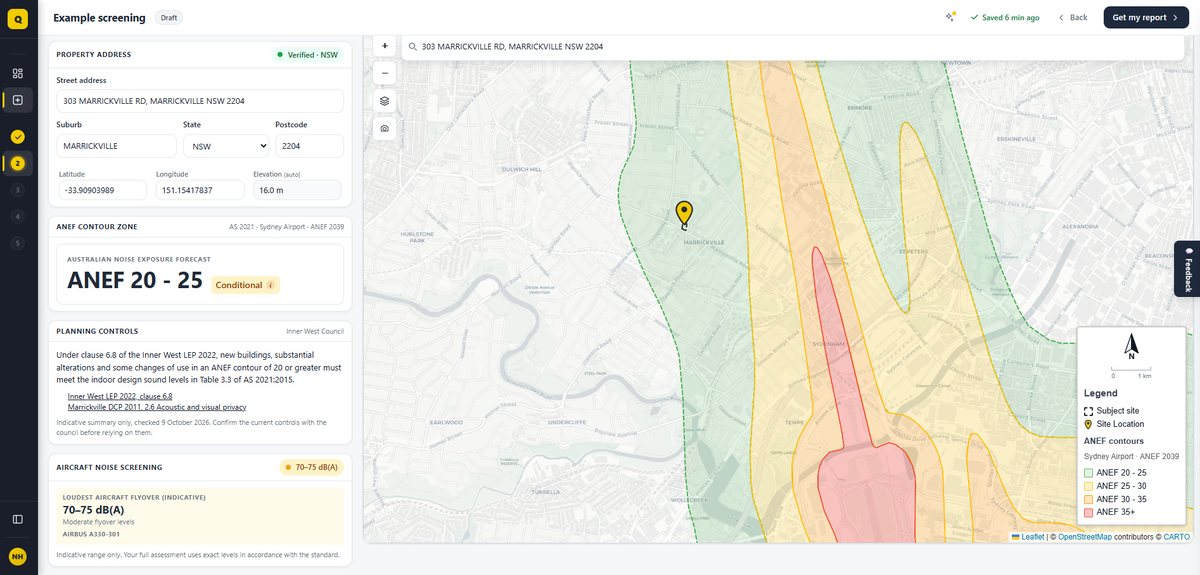
QuietPath's free check is the quicker way. Search the address and it shows the site on the current ANEF at street level, with the band, the Codes SEPP rule that applies and the council's aircraft noise controls.
A checklist for CDCs near an airport
1. Find the band on the airport's current ANEF. If a contour line crosses the lot, check with the council how it applies before choosing the pathway.
2. Confirm the pathway.
- Below ANEF 20: the aircraft noise clauses don't apply.
- ANEF 20 to 25: a new house or an addition can be a CDC if it's built to AS 2021.
- ANEF 25 and above: only ancillary, attached or detached development, or internal alterations. Anything else goes to council.
3. Ask for evidence of AS 2021. Clause 1.18(2) doesn't say what evidence you need, so it's worth being clear with the applicant early. An aircraft noise report from an acoustic consultant is the usual way. A good one states the site's ANEF band, the aircraft noise level the design is based on, and the sound insulation rating each window, door, wall and roof needs, room by room. It should also say how the rooms will be ventilated with the windows shut, because the standard's indoor levels assume they are.
4. Make sure the plans match the report. The window and door schedule should carry the ratings from the report, and the ventilation it relies on should be on the plans. A condition on the CDC tying the work to the report makes it easy to check later.
5. Check it at the end. Before the occupation certificate, check that the windows and doors installed have the specified ratings. Glazing suppliers can usually provide a certificate or test report for the system.
6. Keep it on file. Record the ANEF you checked, the band and the date, along with the report. If the question comes up later, the file answers it.
Granny flats and dual occupancies. Clause 1.18(2) only mentions new dwelling houses and additions. It doesn't spell out a requirement for granny flats or dual occupancies in ANEF 20 to 25. Building them to AS 2021 anyway protects the owner, and costs far less at design stage than as a retrofit.
Near Sydney Airport: what the ANEF 2045 changes
Until February 2026, CDCs near Sydney Airport were checked against the ANEF 2039. The ANEF 2045 has replaced it, and the contours have moved.
The new forecast assumes just over 400,000 flights a year by 2045, more and larger international aircraft, more use of the parallel north–south runway, and Western Sydney International being open. It also uses updated weather data and a newer noise model, the AEDT, which replaced the INM. Even with more and larger aircraft, the contours have mostly shrunk. Newer aircraft types are quieter than the ones they replace, and the change of noise model also affects where the contours fall.
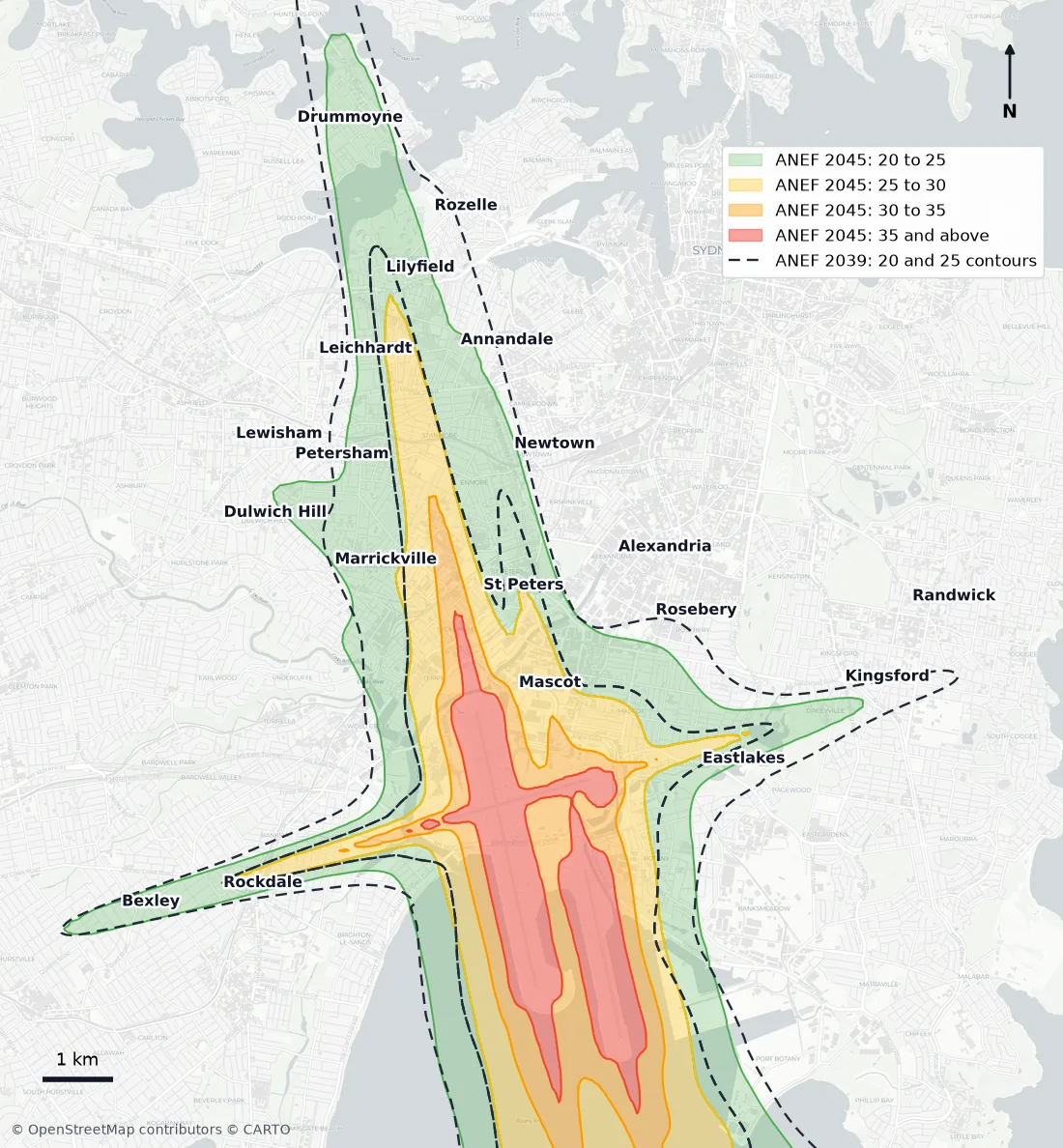
Most of the change is a contraction. The 25 contour has moved back in parts of Mascot, Leichhardt, Lilyfield, St Peters, Eastlakes, Newtown and Petersham, so new houses and extensions there can now be a CDC if they're built to AS 2021. The 20 contour has moved back in parts of Annandale, Rozelle, Lilyfield, Leichhardt, Drummoyne, Kingsford, Randwick, Rosebery, Alexandria, Rockdale and Bexley, where clause 1.18(2) no longer applies. Going the other way, the 20 contour now takes in parts of Dulwich Hill, Marrickville and Lewisham, and a small part of Marrickville has moved into the 25 contour.
So a site checked before February 2026 is worth checking again, along with any design or advice that relied on the old band. That goes both ways: some projects that had to go to council can now be a CDC, and some that didn't need an aircraft noise report now do.
How QuietPath helps
The free check maps the contours for Sydney Airport, Bankstown Airport, Camden Airport, Newcastle Airport and RAAF Base Williamtown, RAAF Base Richmond, Cessnock and Scone. It takes less than a minute and needs no account, so it's easy to run at enquiry stage or send to an applicant.
When a project needs to show it meets AS 2021, the applicant uploads the drawings and a Resonate acoustic engineer prepares the report, usually within days, for sites anywhere in NSW. Each report sets out the band, the design noise level and the aircraft it's based on, the rating for every window, door, wall and roof in each room, and the ventilation needed, so it's straightforward to check against the plans and at the end of the job. Reports for a new home or extension start from $899 including GST.
Sources
- State Environmental Planning Policy (Exempt and Complying Development Codes) 2008, clauses 1.18 and 1.19. Checked October 2026.
- SEPP (Precincts—Western Parkland City) 2021, section 4.17.
- Sydney Airport, ANEF 2045 (Master Plan 2045, endorsed by Airservices Australia 26 February 2026), and the previous ANEF 2039 (Master Plan 2039).
- NSW Planning Portal, online CDC data, for CDCs approved from January 2021 to October 2026 in the council areas around Sydney Airport. Counts are based on the development types recorded on the portal.
- Standards Australia, AS 2021:2015 Acoustics—Aircraft noise intrusion—Building siting and construction. Available from Standards Australia.