Embrace the curve: how real flight paths change AS 2021 at Sydney Airport
As the saying goes, 'there are no straight lines in nature'. Much like nature, aircraft often don't follow straight lines either, and have a tendency to turn soon after take-off. Acoustic engineers on the other hand, seem to prefer the straight and narrow. At Resonate we've learned to embrace the curve.
When we reviewed 105 public aircraft noise reports earlier this month, only 3 of them used the curved flight path method in AS 2021:2015 Acoustics - Aircraft Noise Intrusion - Building Siting and Construction. The remaining 102 reports appeared to assume a straight departure path along the extended runway centreline. Full disclosure: Resonate have made the same assumption in the past too.
However, most jets leaving Sydney Airport turn soon after take-off, so we wanted to know how much that simplification changes the aircraft noise level and therefore the degree of sound insulation required by AS 2021. QuietPath now assesses Sydney sites against the real departure tracks as presented in the 2045 Master Plan. This post compares the two methods at selected addresses inside the ANEF 20 contour.
The method in the standard
AS 2021 Clause 3.1.3.1 covers straight flight paths. Each runway centreline is extended past the site, and aircraft distances (DS, DL and DT in the standard) are measured based on the straight line.
Clause 3.1.3.2 covers curved tracks. The sideline distance DS is measured to the curved track, and DL or DT is the distance flown along it: the straight segment from the runway end plus the curved segment, DC = 2πRA/360. Under the clause, the calculation should be repeated at a number of positions along the curve and not only at the closest one, because the aircraft height and the sideline distance both change through the turn.
According to a note to the clause, the method should be used only where the flight paths used to produce the ANEF are known, and the aerodrome operator should be asked for the track data. We come back to this below.
How QuietPath models the flight paths
For Sydney we traced six jet departure tracks from the flight track maps in the Sydney Airport Master Plan 2045: two for runway 34L, where the jets split into two streams after the left turn, and one each for 34R, 16L, 16R and 07. Each track follows the centre of the departure swathe on the map.
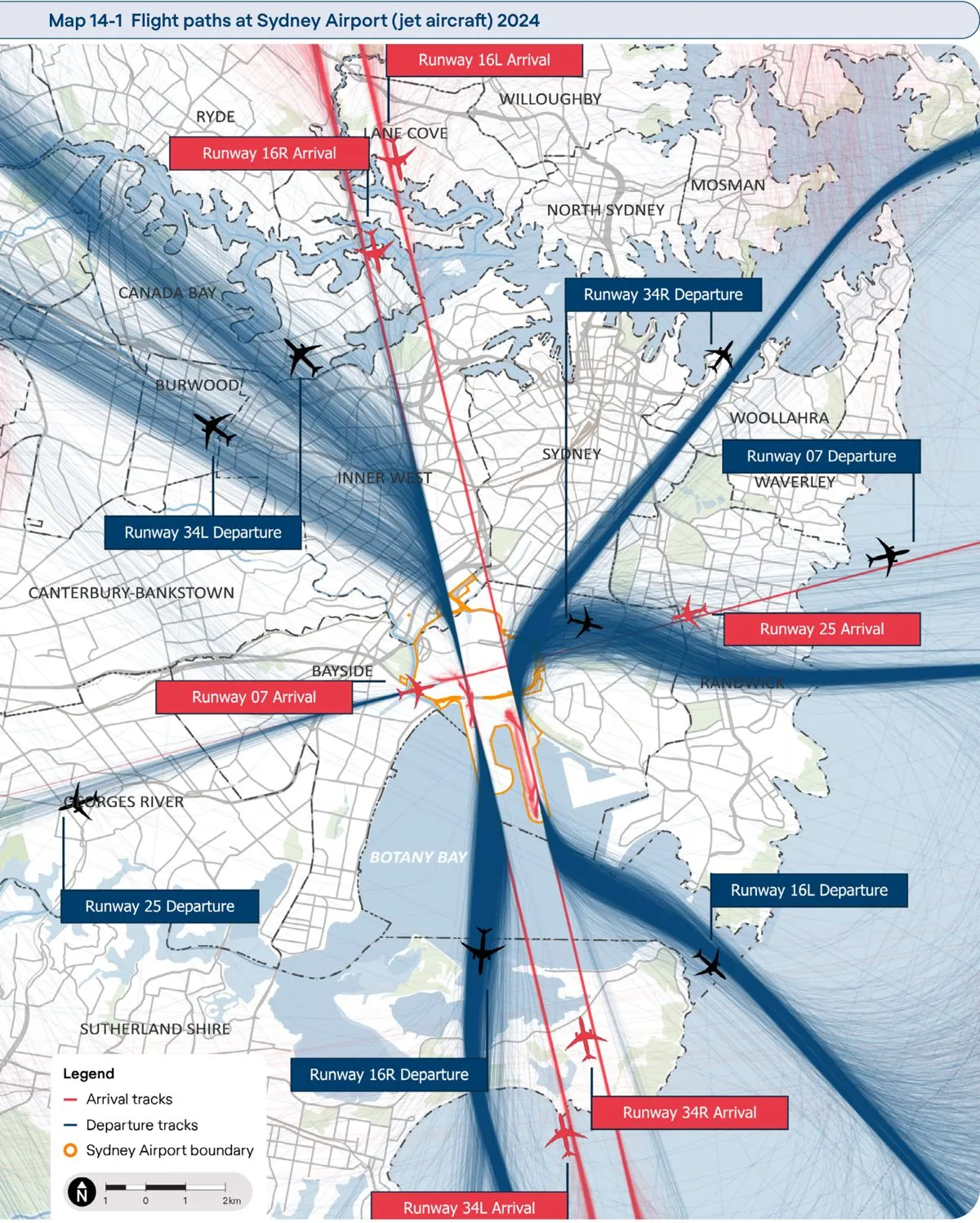
For each site, QuietPath takes positions every 50 m along each track, starting at the start of roll. At each position DS is the distance from the site to the aircraft's ground position and DT is the distance flown along the track, with correction for the site's elevation relative to the airport. The departure tables are read for every aircraft type that uses that runway in the Master Plan 2045 fleet, and the loudest result across all positions, runways and operations sets the design level. Stepping along the track gives the same DT as the arc formula for a single turn, and also handles tracks with more than one turn.
A traced track replaces the straight line only for jets departing that runway end. Arrivals and non-jet departures stay on the extended centrelines. Jet departures from runway 25 generally follow the runway centreline, so we didn't trace a curved path for those.
The ANEF 2045 model tracks aren't published. The traced 2024 tracks are a proxy for them, so this does not follow the exact procedure in the note to cl 3.1.3.2, but does follow its intent. Departures also spread several hundred metres either side of the swathe centre, so at a site near the edge of a swathe the level could be a few decibels higher or lower.
Resonate has typically used the straight flight path method in the past too. With the GIS and spreadsheet tools we used before QuietPath, it is much quicker: one line per runway, instead of a track to trace and a series of positions to check along it. The note in cl 3.1.3.2 also gives a defensible reason not to bother, since the ANEF model tracks are rarely available. And we told ourselves it probably didn't change the outcome much.
QuietPath now uses the curved tracks for every Sydney assessment at no extra effort, which finally let us properly test that assumption. Spoiler alert: It doesn't hold. As you'll see below, the straight departure path simplification used by most consultants over-predicts aircraft noise levels in suburbs like Newtown, St Peters, and Kurnell which are on-axis with the main runways. It under-predicts noise levels in areas like Rosebery, Mascot and parts of Marrickville that are underneath the curved departure tracks.
For typical new builds or extensions, these over- or under-predictions result in meaningful differences in the level of sound insulation required by AS 2021.
The comparison
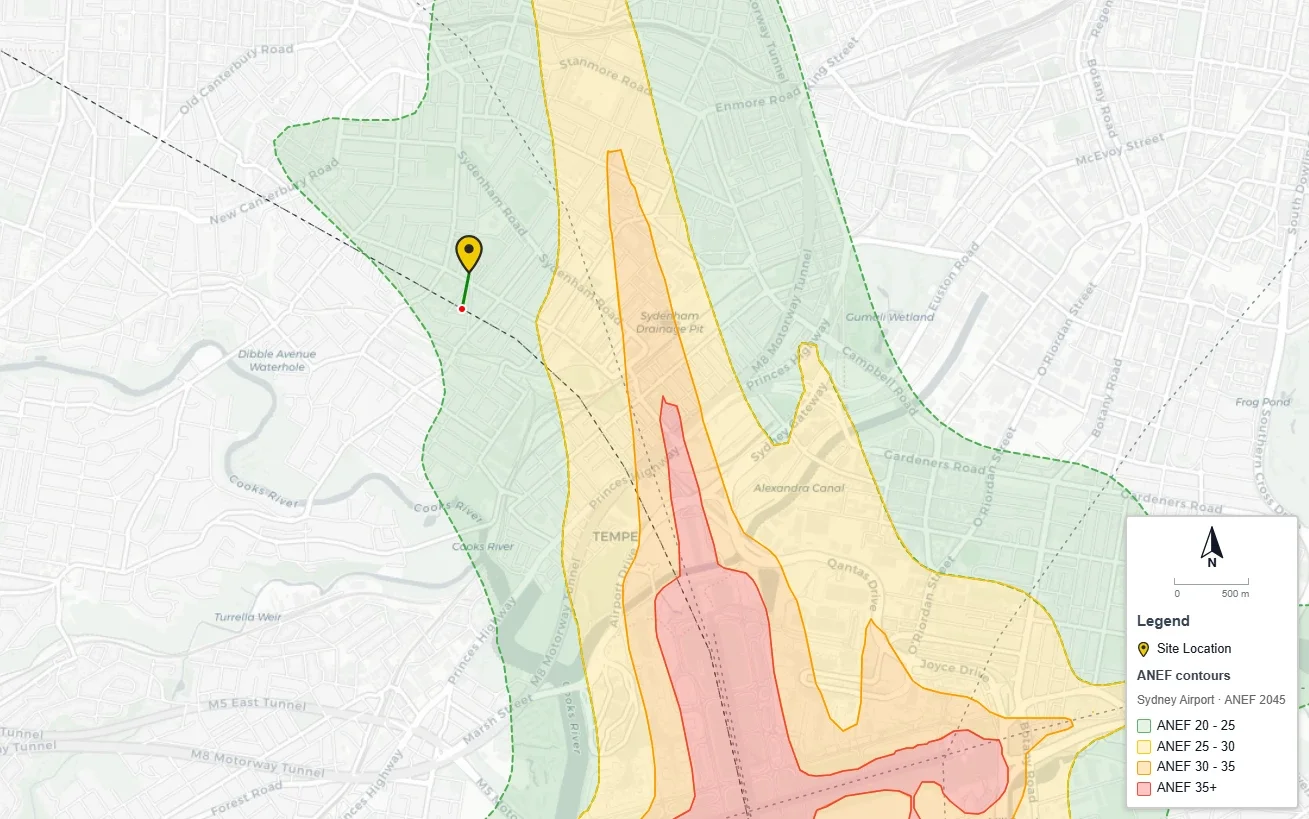
We picked a number of addresses inside the Master Plan 2045 ANEF 20 contour where we thought there would be a significant difference between using straight departure tracks vs real, curved tracks for jet aircraft. The addresses are public buildings rather than real houses, but the results are representative of residences in the vicinity of each. The locations included Newtown, Annandale, Petersham, Marrickville, Tempe, St Peters, Mascot, Rosebery, Botany, Daceyville, Kyeemagh, Rockdale and Kurnell. Each one was assessed twice, with the same inputs, apart from the departure geometry:
- Straight departure tracks: every departure on the extended runway centreline, as in cl 3.1.3.1.
- Real departure tracks: jet departures on the traced tracks, as in cl 3.1.3.2.
The result in each case is the controlling aircraft noise level: the loudest arrival or departure on any runway, after adjusting for the site's Table 3.2 elevation correction.
To show what the difference might mean for a real residential new build or extension, we calculated the required sound insulation for a typical bedroom, in accordance with AS 2021. Our nominal bedroom is single-storey brick veneer, 4 × 4 m with a 2.4 m high, 10 mm plasterboard ceiling, one external wall, 2 m² total window area (casement/awning), and profile metal roof with a 10 mm plasterboard ceiling. We used an internal design level of 50 dB(A), T = 0.5 s and the simplified 6 dB orientation approximation (Kc) from G2.6.1 for every element, and checked the room as a whole.
Results
The table shows the three largest over-predictions and under-predictions for simplified straight jet departure tracks compared to calculations based on the real, curved departure tracks. We also show the glazing sound insulation requirements for our nominal bedroom. It's important to note that sound insulation requirements differ depending on the geometry as well as the level of aircraft noise exposure. Rooms with larger areas of glazing may require more, and houses with lightweight walls may also need wall upgrades.
| Address | ANEF | LAmax, straight tracks | LAmax, real tracks | Sound insulation, straight tracks | Sound insulation, real tracks |
|---|---|---|---|---|---|
| 356 King Street, Newtown | 20–25 | 82 dB(A) | 78 dB(A) | 4 mm standard glass | 4 mm standard glass |
| 93 Church Street, St Peters | 20–25 | 86 dB(A) | 82 dB(A) | 6.38 mm laminated glass | 4 mm standard glass |
| 13–31 Dampier Street, Kurnell | 20–25 | 86 dB(A) | 84 dB(A) | 10.38 mm laminated glass | 6.38 mm laminated glass |
| 190 Livingstone Road, Marrickville | 20–25 | 72 dB(A) | 85 dB(A) | 4 mm standard glass | 6.38 mm laminated glass |
| 827 Botany Road, Rosebery | 20–25 | 72 dB(A) | 87 dB(A) | 4 mm standard glass | 10.38 mm laminated glass |
| 207 King Street, Mascot | 25–30 | 80 dB(A) | 91 dB(A) | 4 mm standard glass | 12.5 mm laminated glass and/or large cavity acoustic double glazing. Ceiling upgrades also required. |
The figure below shows the change in the highest LAmax aircraft noise level for all areas within the ANEF 20 contour.
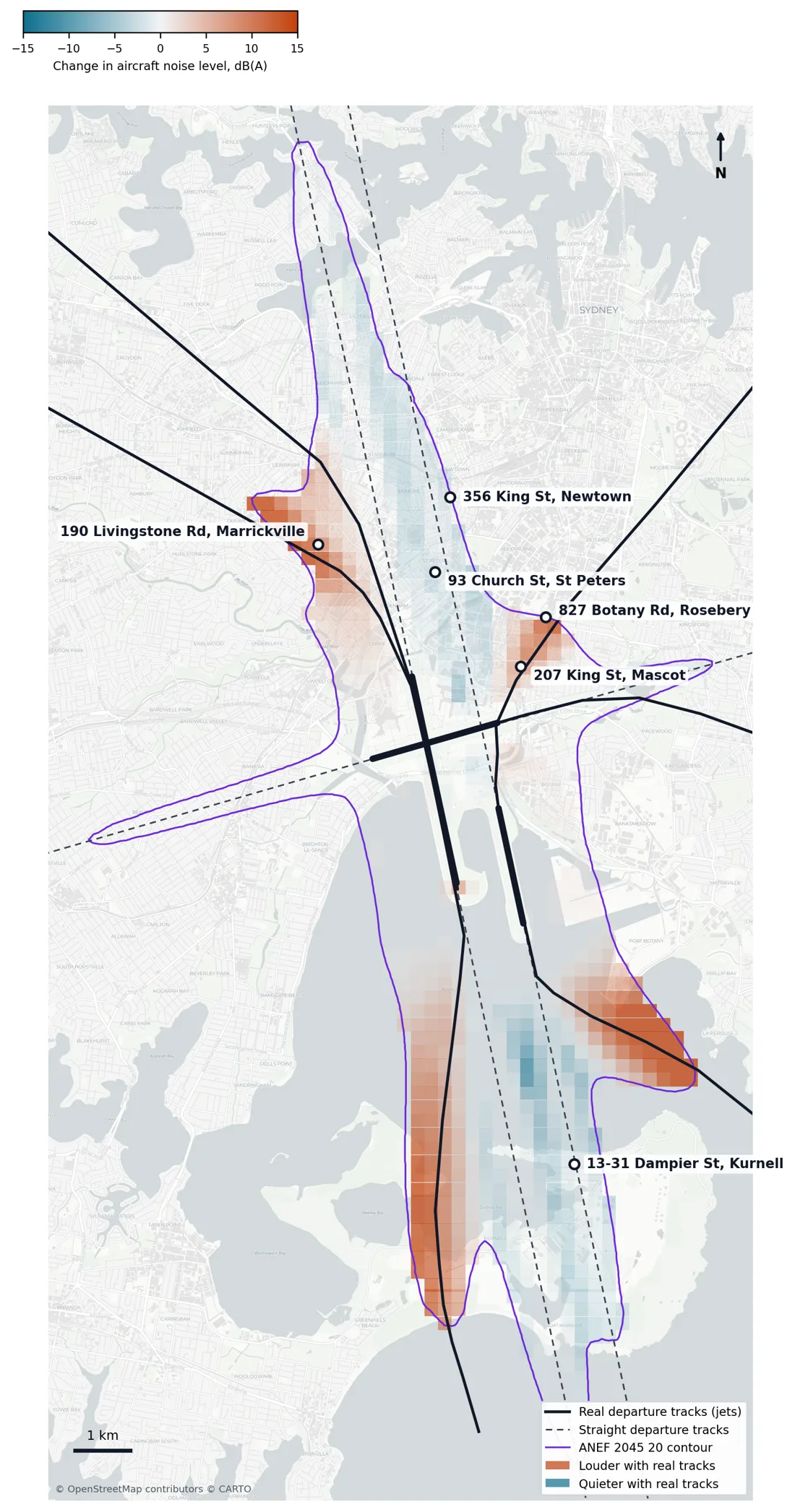
In general, the increases are larger than the decreases; as expected, these occur in areas under the real departure tracks but off runway axes: the 34L track over Marrickville and the 34R track over Mascot and Rosebery. 827 Botany Road, Rosebery went up by 15 dB. 207 King Street, Mascot went from 80 to 91 dB(A), which takes the study bedroom from standard 4 mm glass to high spec acoustic glazing plus roof/ceiling upgrades.
The largest fall was approximately 4-5 dB at 356 King Street, Newtown, 328 m from the extended 34R centreline. The 34R jets turn right well before Newtown, but 16L arrivals still pass overhead on the centreline, so the level only dropped from 82 to 78 dB(A). St Peters and Kurnell are similar: the departures move away and the arrivals stay. At Newtown the test bedroom only needed standard 4 mm glass either way. At St Peters and Kurnell, using straight departure tracks would mean specifying laminated acoustic glass when it probably isn't required for AS 2021 compliance.
We also ran a 250 m grid over the whole ANEF 20 area, 1,109 points including Botany Bay, without elevation corrections. The real departure tracks raised the level by 5 dB or more at 196 points and lowered it by 5 dB or more at 79.
What this means for assessments near Sydney Airport
At the selected addresses, straight departure tracks underestimated the aircraft noise level by up to 15 dB under the turns and overestimated it by up to 5 dB under the extended centrelines north of the airport. Either difference is enough to change the glazing requirements for a typical bedroom. In the worst cases, the wall and roof/ceiling linings would also likely change. These changes have significant construction cost implications, orders of magnitude larger than typical acoustic consulting fees.
There is an irony here. Departure tracks often turn to reduce noise over densely populated suburbs. The straight-line method undoes that in the assessment. Suburbs the turns are meant to protect, such as Newtown and St Peters on the extended 34R centreline, are assessed as if the jets still flew overhead. Meanwhile, homes in Mascot, Rosebery and parts of Marrickville that sit right under the turning tracks can end up with minimal acoustic treatment.
The ANEF 2045 contours are modelled with the curved tracks. A site can therefore be inside ANEF 20 because of a turning departure track and then be assessed against a straight centreline more than a kilometre away. 190 Livingstone Road and 303 Marrickville Road in Marrickville are both in that position.
Real departure tracks are now the default for Sydney assessments in QuietPath, and the site map shows the track and position that set the design level. If you have the ANEF model tracks for an airport, or think one of our Sydney tracks is in the wrong place, email info@quietpath.com.au.
Sources
- Standards Australia, AS 2021:2015 Acoustics—Aircraft noise intrusion—Building siting and construction, clauses 3.1.3 and 3.1.4, Tables 3.2 and 3.3, Appendix G. Available from Standards Australia.
- Sydney Airport, Master Plan 2045: flight track maps (Map 14-1 reproduced with permission), ANEF 2045 contours and forecast fleet.
- Site elevations from Geoscience Australia 5 m LiDAR and 1-second digital elevation models. Building locations from OpenStreetMap. Constructions and Rw values from QuietPath's construction catalogue. Base map © OpenStreetMap contributors © CARTO.